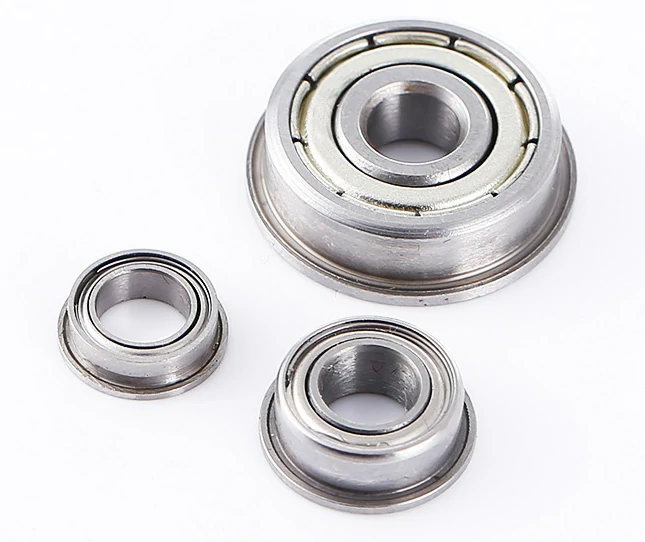
Flange bearing types, There are some classifications and characteristics of flange bearings, which will be elaborated in detail below
المحتويات
1. Y Bearings
Y bearings are double-row محمل كرويs featuring spherical inner and outer rings that allow free rotation. They are suitable for low-speed applications involving heavy loads and impact loads.
2. UCF Bearings
UCF bearings are four-corner cantilever flange bearings offering exceptional load-carrying capacity and protection. They are ideal for various heavy-duty machinery and equipment.
3. UCFL Bearings
UCFL bearings are two-corner flanged bearings incorporating spherical bearings and end caps to prevent dust and moisture ingress, making them suitable for harsh operating environments.
4. UCT Bearings
UCT bearings are orientation flanged bearings that enable axial positioning by adjusting bearing orientation, ideal for applications requiring high positioning accuracy.
5. UCP Bearings
UCP bearings are tapered bore flange bearings incorporating spherical bearings and end caps. They offer high load capacity and self-lubricating properties, making them suitable for high-speed rotation applications.
The table below presents common flange bearing models, dimensions, parameters, specifications, and types for reference.
Model Dimensions سعة الحمولة Rotational Speed Applications
Y Bearing
20-100mm
200-500kN
100-500r/min
Low speed, high load, impact load
UCF Bearing
20-200mm
300-1000kN
100-800r/min
Heavy-duty machinery
UCFL Bearing
20-200mm
300-800kN
100-800 r/min
Harsh operating environments
UCT bearings
20-200 mm
200-500 kN
100-500 r/min
High positioning accuracy requirements
UCP bearings
20-200 mm
300-1000 kN
100-800 r/min
High-speed rotation
Flange bearings are one of the most commonly used bearing types in mechanical equipment. Selecting the appropriate flange bearing for different applications ensures optimal machinery operation. When choosing bearings, consider not only the model and dimensions but also critical parameters such as load capacity, rotational speed, and suitability for specific operating conditions to guarantee the selection of the most appropriate bearing.

 English
  العربية
  Deutsch (Sie)
  Español
  Français
  Bahasa Indonesia
  Italiano
  日本語
日本語  Português
  Русский
  Türkçe
  简体中文
简体中文  Nederlands (Formeel)
  Svenska