High-speed motors, precision machine tools, chemical equipment and wet outdoor machinery often break down easily. Standard steel bearings frequently overheat and seize, suffer electrical erosion, or rust and jam. These failures create major downtime headaches for factories and maintenance teams. Ceramic bearings deliver lightweight, insulating, corrosion-resistant and high-temperature performance. More maintenance technicians and plant engineers choose ceramic bearings to upgrade their equipment.
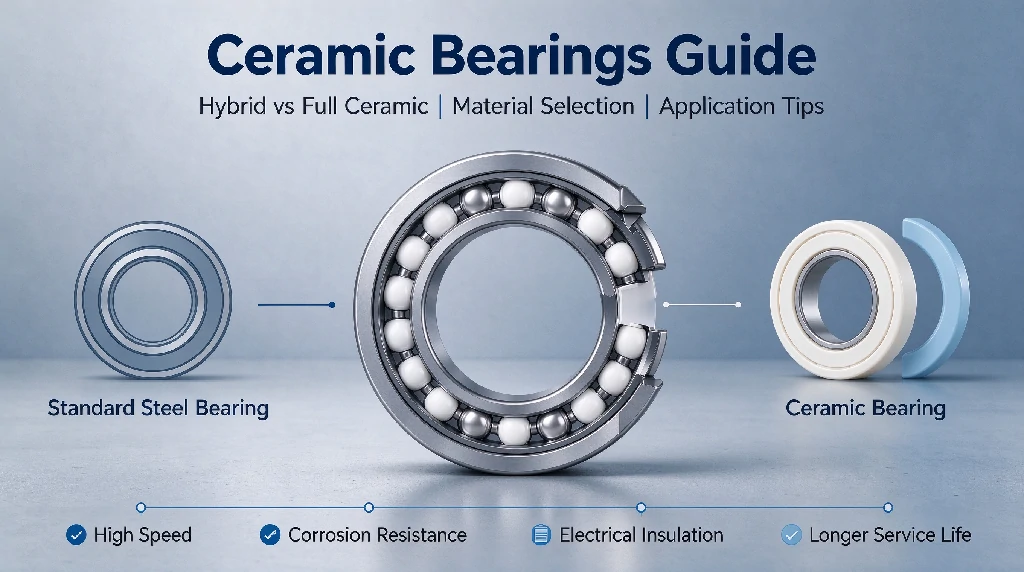
However, ceramic bearings cover many types with wide price gaps. Many buyers pick the wrong model and waste budget. This guide helps you understand ceramic bearings, identify suitable working conditions, and select the right bearing without unnecessary costs.
Inhalt
Standard bearings use bearing steel for all components. Ceramic bearings replace rolling balls, or even inner and outer rings, with ceramic materials. Ceramic bearings cost more because they fix five critical weaknesses of steel bearings and lift overall equipment performance.
This structural choice directly controls cost performance and applicable working conditions.
Structure: Inner and outer rings stay high-hardness bearing steel, while rolling balls use ceramic. This option dominates most industrielle Anwendungen and offers the best value.
Advantages: It combines steel’s toughness with ceramic’s wear resistance, insulation and high-speed capability. It resists shock and impact better than full ceramic bearings.
Disadvantages: Inner and outer rings remain steel, so it cannot withstand extreme strong acid, strong alkali or ultra-high temperature environments.
Applications: High-speed factory motors, machine tool spindles, fans, automation equipment and most high-cycle rotating machinery.
Structure: Inner rings, outer rings and rolling balls all use ceramic with zero metal parts.
Advantages: It is completely non-magnetic and non-conductive. It delivers full corrosion resistance and works long-term in seawater, strong acid/alkali, vacuum and high-temperature furnaces.
Disadvantages: It is brittle, vulnerable to drops, bumps and overload impact. It carries a high price tag.
Applications: Seawater pumps, chemical reactors, medical & food sterile machines, semiconductor vacuum equipment and high-temperature kilns, environments where steel bearings cannot survive.
Ceramic materials perform differently. Pick the right material to maximize Lagerservice life.
| Comparison Item | Standard Steel Bearing | Ceramic Bearing |
|---|---|---|
| High-speed Operation | Easy to overheat and seize; speed limit exists | Stay cool at high speed, fit ultra-high rotation speed |
| Service Life | Wear fast, require frequent replacement | 3–10 times longer service life, less maintenance & replacement |
| Motor Protection Against Burnout | Conductive; electric current causes erosion, abnormal noise | Non-conductive, fully eliminate electrical corrosion |
| Water & Corrosion Resistance | Rust quickly under moisture and salt spray | Rust-free, corrosion resistant, reliable in harsh environments |
| Impact Toughness | Tough, withstand bumps and rough handling | Relatively brittle, avoid knocks and drops; need careful installation |
| Procurement Cost | Low price, good basic cost performance | Higher upfront cost, but lower long-term maintenance cost |
| Running Noise | Noise rises after long time wear | Run smooth and quiet, maintain precision well |
| Performance Index | Ceramic Bearing Advantage | Why It Matters |
|---|---|---|
| Lighter Weight | Only 40% weight of steel | Smaller centrifugal force during high-speed rotation, low heat generation, smoother operation |
| Higher Hardness | Smooth surface, extremely low wear rate | Service life reaches 3–10 times of steel bearings, reduce downtime for replacement |
| Non-conductive | Ceramic works as insulator | Fully stop shaft current erosion on motors and inverters, eliminate abnormal noise and seizure |
| Rust-free | Resist acid, alkali, seawater and salt spray | Never rust in humid, chemical and harsh working environments |
| High Temperature Resistance | No deformation under high temperature, stable thermal performance | Will not seize from thermal expansion under high-temperature working conditions |
Proper installation decides most of ceramic bearing service life. Wrong operation destroys expensive ceramic bearings quickly.
Ceramic bearings do not solve all mechanical problems. They target five core pain points: high-speed overheating, motor electrical erosion, rust in humid conditions, fast wear and precision quiet running.
For daily maintenance and factory retrofit, silicon nitride hybrid ceramic bearings deliver the best overall performance. Pick zirconia bearings for waterproof and anti-corrosion needs. Only choose silicon carbide bearings for extreme high temperature and heavy corrosion environments.
Remember core limits: avoid knocks, drops, overheating, dirt and overload. Standard installation doubles bearing life; rough operation destroys it immediately.
Selection principle: Do not over-specify for standard working conditions. Upgrade timely for harsh environments. Proper matching saves your total cost.
Q: What is hybrid ceramic bearing?
A: Hybrid ceramic bearings use steel inner/outer rings and ceramic rolling balls. It balances toughness, high speed and insulation performance for most industrial applications.
Q: What is the difference between full ceramic bearing and hybrid ceramic bearing?
A: Full ceramic bearings use all ceramic components for extreme corrosion and high temperature, but they are brittle and expensive. Hybrid ceramic bearings offer better impact resistance and cost advantages for general high-speed equipment.
Q: Which ceramic bearing material works best for high speed motors?
A: Silicon nitride hybrid ceramic bearing is the top choice for high-speed motors and machine tool spindles.
Q: Can ceramic bearings replace steel bearings directly?
A: Not all cases. Ceramic bearings suit high speed, anti-electric-erosion or corrosion-resistant scenarios. Do not use ceramic bearings for low-speed heavy shock loads.
 English English
  العربية
 Deutsch (Sie)
 Español
 Français
 Bahasa Indonesia
 Italiano
 日本語
日本語
 Português
 Русский
 Türkçe
 简体中文
简体中文
 Nederlands (Formeel)
 Svenska
